

The Director of the United States Patent and Trademark Office has received an application for a patent for a new and useful invention. The title and description of the invention are enclosed. The requirements of law have been complied with, and it has been determined that a patent on the invention shall be granted under the law.
Therefore, this United States grants patent to the person(s) having title to this patent the right to exclude others from making, using, offering for sale, or selling the invention throughout the United States of America or importing the invention into the United States of America, and if the invention is a process, of the right to exclude others from using, offering for sale or selling throughout the United States of America, products made by that process, for the term set forth in 35 U.S.C. 154(a)(2)or (c)(1), subject to the payment of maintenance fees as provided by 35 U.S.C. 41(b). See the Maintenance Fee Notice on the inside of the cover.
If the application for this patent was filed on or after December 12, 1980, maintenance fees are due three years and six months, seven years and six months, and eleven years and six months after the date of this grant, or within a grace period of six months thereafter upon payment of a surcharge as provided by law. The amount, number and timing of the maintenance fees required may be changed by law or regulation. Unless payment of the applicable maintenance fee is received in the United States Patent and Trademark Office on or before the date the fee is due or within a grace period of six months thereafter, the patent will expire as of the end of such grace period.
If the application for this patent was filed on or after June 8, 1995, the term of this patent begins on the date on which this patent issues and ends twenty years from the filing date of the application or, if the application contains a specific reference to an earlier filed application or applications under 35 U.S.C. 120, 121, 365(c), or 386(c), twenty years from the filing date of the earliest such application (“the twenty-year term”), subject to the payment of maintenance fees as provided by 35 U.S.C. 41(b), and any extension as provided by 35 U.S.C. 154(b) or156 or any disclaimer under 35 U.S.C. 253.
If this application was filed prior to June 8, 1995, the term of this patent begins on the date on which this patent issues and ends on the later of seventeen years from the date of the grant of this patent or the twenty-year term set forth above for patents resulting from applications filed on or after June 8, 1995, subject to the payment of maintenance fees as provided by 35 U.S.C. 41(b) and any extension as provided by 35 U.S.C. 156 or any disclaimer under 35 U.S.C. 253.
Krukowski et al.
Min et al., The Friedel—Crafts Allylation of a Prenyl Group Stabilized by a Sulfone Moiety: Expeditious Syntheses of Ubiquinones and Menaquinones, J Org Chem., vol. 68, No. 20, 2003, pp. 7925-7927.T. Wirth et al.: “Organoselenium Chemistry, Modern Developmentsin Organic Synthesis”, 2000, Springer.
Primary Examiner — Ana Z Muresan(74) Attorney, Agent, or Firm — Renner Kenner Greive Bobak Taylor & Weber Co., LPA
The invention relates to a method and intermediate compounds for the preparation of menaquinone MK-7. The method for the preparation of menaquinone MK-7 is characterized in that, it comprises coupling of a compound of formula (11) with a compound of formula (17) in the presence of a base, to obtain a compound of formula (18), which is subjected to desulfonylation reaction in the presence of a palladium catalyst, to obtain a compound of formula (19), which is subjected to oxidation reaction, to obtain menaquinone MK-7. The invention also relates to compound (8), preferably in a crystalline form, which is a convenient intermediate compound for the preparation of menaquinone MK-7.
Nov. 18, 2025
US 12,473,248 B2
The invention relates to a method and intermediate compounds for the preparation of menaquinone MK-7, also known as vitamin K2.
Menaquinones are derivatives of 1,4-naphtoquinone, which in position 2 contains a methyl group, and in position 3 a chain consisting of variable number of isoprene groups. Menaquinones are often defined by the abbreviation “MK-n”, where n indicates a number of unsaturated isoprene groups at C3 carbon. Menaquinones MK-4 and MK-7 show biological activity towards a protective effect on bone density and are known under a common name—vitamin K2. MK-7 shows better bioavailability than MK-4, but in contrast to the latter, it is not produced in human cells. MK-7 as an ingredient of dietary supplements is obtained as a product of biosynthetic processes such as e.g., fermentation of soybeans, as well as a product of chemical synthesis processes in multi-kilogram scale. In multistep syntheses of MK-7 a step of coupling amenadiol derivative with an isoprene chain plays a key role. A measure of the success of this transformation is simultaneous achievement of several goals: the product should be of high isomeric purity of isomer E; the reaction should be of high yield possible; raw material and catalysts of the reaction should be cheap, easily available and chemically pure; the reaction should be performed in conditions that does not require special regime being e.g., anhydrous conditions. The final requirement needed for the reaction to be performed on an industrial scale is an ease of purification of the product. At the moment, there are no publications known, which gives a pure product after the coupling step without tedious, on an industrial scale, column chromatography. Additionally, in most cases chromatography does not allow to separate fractions of undesired geometric isomers. Min et al. in J Org Chem. 2003; 68(20): 7925-7927, discloses a method for the preparation of menaquinones, where 1,4-dimethoxy2-methylnaphthalene is reacted with (E)-4-hydroxy-2-methyl-1-phenylsulfonyl-2-butene in Friedel-Crafts reaction, in the presence of various Lewis acids. Most of the reaction products are formed as a E/Z mixture of isomers in a ratio from 3:1 to a maximum of 10:1. The yields of most reactions are moderate, isolation of the products requires column chromatography, as well as no isolation of any product in a crystal form is mentioned. WO/2010/035000 A1 discloses a synthesis strategy of MK-7 and other menaquinones using e.g., Kumada chemical reaction to combine an isoprene chain with a menadiol protected with an alkyl group. Troublesome conditions of combing organomagnesium derivatives of menadiol with isoprene chain were used in the synthesis, in the presence of a catalyst of the group of rare earth metals. In the 2+5 variant of the synthesis (the numbers correspond to the number of isoprene groups in compounds to be coupled), purification
of the product of coupling reaction requires a chromatography at this step, or in the next step of oxidation of terminal isoprene group in allyl position. After the chromatography, the product in a form of an oil was obtained with low yield and of unspecified isomeric purity. In further steps, Biellmann reaction was used as a standard, by coupling abromide with previously prepared sulfone. It should be mentioned here, that penta- and heptaprenols used in the patent document, do no have easily available natural sources and they are usually a product of multistep coupling of commonly available two- and three isoprene alcohols. WO/2014/058330 A2 discloses a method of preparation of MK-7 (1+3+3), where Friedel-Crafts reaction is used to incorporate a first isoprene unit to a menadiol protected with an ethyl group. After prior separation of the reaction mixture by column chromatography, a crystalline derivative was obtained with low yield. In further construction of the isoprene chain Biellmann reaction was used, coupling isoprene chain constructed from famesol. It should be noted that, the oxidation reaction of terminal allyl position of famesol used in the process is a low regioselectivity reaction, generating large amounts of constitutional isomers and side products, forcing to use a tedious purification of the product using chromatography. WO/2019/191690 A1 discloses a method of preparationof MK-7, where allyl group is used to protect menadiol. The key step of ring alkylation requires use of equimolar amounts of Lewis acid. In order to purify the product, it is necessary to use chromatography, and the product is an oil with unspecified isomeric purity. For the construction of isoprene chain geraniol and its oxidized derivatives were used (1+2+2+2), that results in a need of desulfonylation of as many as three sulfonyl groups in a process employing mercury amalgams. To sum up, at the moment no examples of a synthesis of menaquinone MK-7 were found, where alkylation of menadiol ring would take place with high yields in early synthetic steps using cheap and easily available reagents, and without the use of column chromatography in a process of semiproduct purification. Therefore, there is still a need to increase yield, and decrease total costs of the synthesis of MK-7.
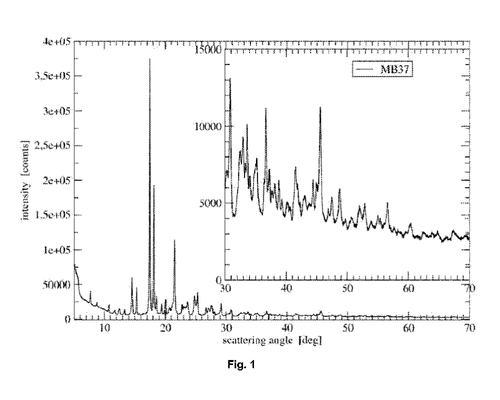
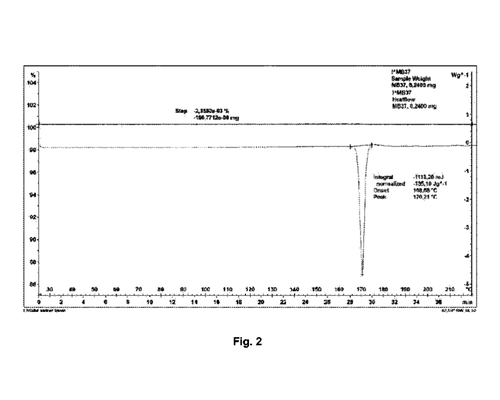
The aim of the present invention is to provide a new method for the preparation of MK-7, the method allowing to solve a problem of low total yield, and also where tedious chromatographic purification steps are minimized, while keeping high purity of the final compound. Another aim of the present invention is to provide intermediate compounds useful for the preparation of MK-7, the intermediate compounds which can be easily prepared on an industrial scale. The authors of the present invention found that it ispossible to perform a step of coupling a menadiol derivative with an isoprene chain, with good yield using cheap and easily available raw materials. The authors of the present invention obtained, as a result of coupling step, a new compound, which was unexpectedly obtained in a crystalline form, significantly improving scalability of the process and yield of the MK-7 synthesis. According to the first aspect, the essence of the inventionis to provide a method for the preparation of MK-7, i.e. a menaquinone of formula (20).

