
Many dietary supplement manufacturers advertise their products containing vitamin K₂ from a so-called "natural" source as better and safer than synthetic raw material. In reality, the biotechnological process commonly referred to as "natural" also takes place in industrial reactors under artificial conditions, and can generate post-process contamination or GMO residues⁽l⁾ if done incorrectly. On the other hand, a cleanly conducted organic synthesis process leads to a product with a purity even above 99.97%.

Producers who choose cheap raw material from outside the EU and focus only on meeting the dose requirement to secure their label and health claims, may often be in breach of EU food laws. Vitamin K₂ is considered a novel food according to Regulation No. 2017/2470. Synthetic menaquinone-7 authorization was first issued to a Norwegian company Kappa Bioscience AS in 2012. The document approving the product in the EU included acceptable safe levels of impurities: maximum 6% of the cis isomer and maximum 2% of other unknown impurities. For "natural" vitamin K₂, the first authorization was issued to a Norwegian company Nattopharma ASA. The EFSA-authorized microbiological process uses a strain of Bacillus subtilis spp. natto, and results in a final product containing max 1% MK-6 impurity and max 2% of the sum of all unknown impurities. In accordance with current EU laws, all manufacturers and importers of vitamin K₂ are required to meet the above-mentioned quality criteria, or to classify the ingredient they introduce as the novel food subject to a separate authorization.
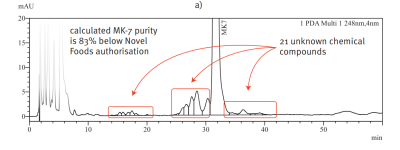
Menaquinone-7 (MK-7) is a mixture of isomers, where only the trans isomer has significant biological activity. Isomerization of the vitamin can occur during production, regardless of whether it is produced by synthetic or biotechnical methods, therefore obtaining raw material 100% "all-trans” MK-7 is difficult to achieve. Currently, the most common method of MK-7 quality control is that contained in the USP monograph⁽²⁾. The method, developed in 2010-2012, reflected the early state of technical knowledge on the purity of vitamin K₂ at that time. Significant progress was made in this field over the following years, largely thanks to the work of Polish scientists from the Pharmaceutical Institute, led by Dr. Łukasz Jedynak, who presented a new methodology for verification of assay and purity of vitamin K₂. The method⁽³⁾ allowed for a significantly greater determination of impurities than the USP method, "handling", so to speak, the residual impurities parameter that is missing in USP. Raw materials tested by the USP method may have an overestimated assay of trans MK-7, and simultaneously an underestimated total of residual impurities in the production process. What's more, the USP method of determining isomeric purity imposes only one acceptance criterion (cis isomer content), causing many manufacturers to ignore the more important assessment related to consumers' health and the novel food authorization criteria: a safe limit of unknown impurities.
"The vitamin category, particularly vitamin D₃ and K₂ market, is a very lucrative slice of the pie, over which the largest players fiercely compete. A large part of the market is made up of products presented in the form of drops and twist-off capsules aimed at the elderly and children. Unfortunately, analysis of marketplace products shows that not everyone is playing fair". High sales increase the temptation to save costs, even at the expense of consumer's safety. Lab results reveal samples failing to meet Novel food criteria, with unknown impurities as high as double digits. What does this mean for the consumers? It means that each dose (usually1 00mcg) serves an additionally significant portion of post-process contaminants to unaware consumers, and contrary to the law, is not disclosed on the supplement label. In result consumers purchasing vitamin K₂ products are misled and their purchasing decisions are not fully informed choices
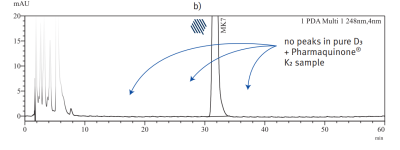
Manufacturers who expect a finished product of the highest quality should choose their raw material from a supplier strictly compliant with the latest and most sensitive quality control methods. One such supplier is Vitasynth sp. z o.o. of Warsaw, a provider that has managed to expand on Dr Jedynak's methodology, adopting it for oil vit. K₂ dilutions used for the production of soft capsules and drops, as well as powder dilutions for the production of tablets, sachets and hard capsules. The raw material under the Pharmaquinone® brand is offered on perfectly inert MCT and MCC carriers giving a perfectly pure HPLC image. All the above-mentioned finished forms containing vitamin K₂ can be best produced in a private label format in cooperation with the sister company Europharma Alliance, which has extensive experience and a modern production plant near Wrocław.
References:
“Strategies for assessing the safety of foods produced by biotechnology” Report of a Joint FAONVHO Consultation, World Health Organization, Geneva, str. 18 - 292. US Pharmacopoeia, Dietary Supplements, First Supplement to USP 38-NF33, United States Pharmacopeial Convention, 2012, pp. 7288–72903. Jedynak Ł., et al. (2016). A novel method for the determination of chemical purity and assay of menaquinone-7. Comparison with the methods from the official USP monograph. Journal of Pharmaceutical and Biomedical Analysis.


